
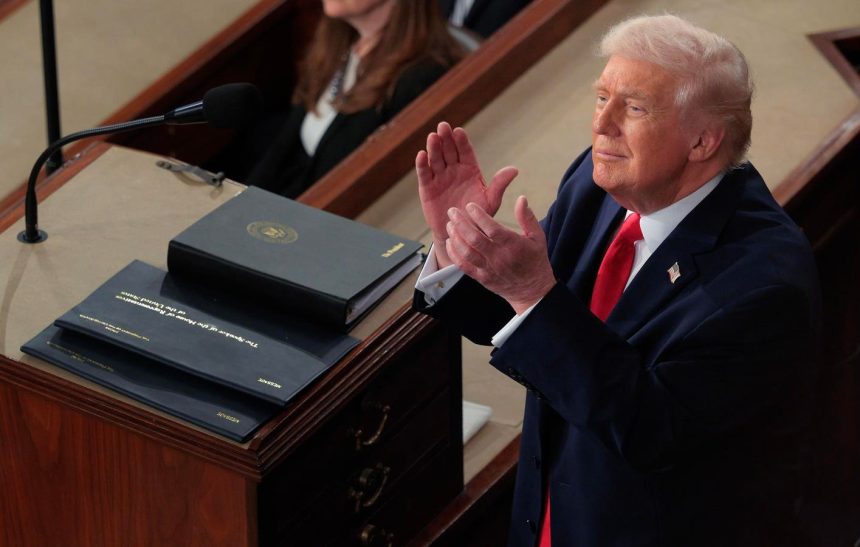
Last night at the State of the Union, President Trump announced an executive action to create a federal retirement savings option for workers without employer-sponsored plans. “My administration will give these often-forgotten American workers — great people, the people that built our country — access to the same type of retirement plan offered to every federal worker,” he said. “We will match your contribution with up to $1,000 each year as we ensure that all Americans can profit from a rising stock market.”
If implemented effectively, this would be one of the most consequential administrative actions in decades aimed at closing a glaring hole in the U.S. retirement system: the coverage gap.
The Coverage Gap Is Real — And Deeply Unequal
At least 54 million U.S. workers lack access to an employer-sponsored retirement plan according to the Pew Charitable Trusts. Roughly half of full-time workers and the vast majority of part-time and gig workers have no workplace plan at all.
According to the Economic Innovation Group, 78.7 percent of full-time workers in the lowest-earning decile (earning less than $27,400 annually) lack access to a retirement plan, compared to just 18.2 percent in the highest-earning decile (earning more than $180,600).
To describe the regressivity of our current system in another way: about one-quarter of workers in the top half of the income distribution lack access, while 65.2 percent of the bottom half are shut out of workplace retirement savings altogether.
This is not simply a participation problem. It is a structural access problem that maps directly onto income inequality.
Without payroll deduction, automatic enrollment, and employer sponsorship — the mechanisms proven to increase participation — retirement saving rates collapse. Workers earning less are both less likely to have access and less likely to benefit from tax incentives structured around voluntary contributions.
Why the Refundable Saver’s Match Matters
The executive action would use existing administrative authority to establish automatic retirement accounts for uncovered workers and pair them with the refundable Saver’s Match taking effect in 2027 under SECURE 2.0.
That pairing is essential.
Under prior law, the Saver’s Credit was nonrefundable and buried in the tax code. Many low-income workers received little or no benefit because they lacked sufficient tax liability. Beginning in 2027, SECURE 2.0 converts the credit into a refundable Saver’s Match — up to 50 percent of the first $2,000 contributed, with a maximum $1,000 match, deposited directly into a retirement account. Data from the Brookings Institution shows why the refundable part is critical and a big deal. Many workers do not make enough to pay any taxes and take advantage of the tax deduction for retirement account contributions. That means the tax breaks benefited mostly stable, well-paid workers.
Research I conducted with Kevin Hassett found that a federal match substantially increases participation among low- and moderate-income workers when accounts are simple, automatic, and accessible.
Unlike the Obama-era MyRA program — which lacked a meaningful financial incentive — the Trump Administration action combines universal access with a real federal match. That is a serious administrative intervention and a serious pivot away from hoping all employers would voluntarily setup a workplace retirement plan and contribute to it.
It is important to note that the Trump executive order is a complement to the bipartisan Retirement Savings for Americans Act (RSAA), sponsored by Senators John Hickenlooper and Thom Tillis and Representatives Terri Sewell and Lloyd Smucker.
If implemented broadly, this executive action could reach a substantial share of currently uncovered workers — the most meaningful step toward universal coverage since Social Security was passed in 1935.
But Access Is Not Adequacy
According to the OECD’s Pensions at a Glance 2025, the United States has one of the highest old-age poverty rates in the G-7 — 22.9 percent — far above countries such as the Netherlands, which combines a universal public pension with strong occupational coverage.
Coverage expansion alone will not fix deeper structural weaknesses:
- Congress has not added more money to Social Security to stave off its financing shortfall in the early 2030s.
- The current tax breaks for retirement savings are top-heavy, favoring the well-off. The Urban Institute estimates more than $400 billion annually in retirement tax expenditures disproportionately benefits higher-income households, with only a small fraction reaching the bottom half of earners calculates the Center on Budget and Policy Priorities. The refundable tax credit offsets this regressivity slightly. More is needed.
- Advocacy for worker retirement security has been muted with the erosion of union rights and defined benefit pensions.
- Retirement savings remains voluntary and thus participation will always be incomplete, especially among those who need to save and do so early in their careers to get the most out of compound interest.
- Wage growth – thus the ability to voluntarily save – for many workers has stagnated in the last 40 years.
Workers least able to bear market, financial, and longevity risk are asked to shoulder those risks alone.
An automatic account with a $1,000 federal match will likely increase participation. It does not guarantee adequate lifetime income. The RSAA – which needs Congress to pass – has larger contributions and covers more workers.
A Policy Opening — If Congress Acts
Executive action cannot substitute for legislation. But it may create a policy opening for the RSAA which would:
- Mandate automatic enrollment for all eligible workers.
- Expand eligibility and income thresholds for the federal Saver’s Match.
- Increase the match rate and include a baseline automatic contribution for workers unable to contribute immediately.
- Protect the federally funded match from market risk.
- Strengthen Social Security financing and benefits.
Unlike our peers — the Netherlands, the U.K., Australia and others — the United States stands out for failing to build large-scale, advance-funded retirement supplements alongside Social Security. Other advanced economies pair public pensions with mandatory or near-universal funded accounts. We do not. This executive action may be the closest the U.S. has come administratively to narrowing that gap and beginning to catch up.
Getting workers into a funded plan early is not ideological — it is arithmetic. The power of compound returns means that time in the market does most of the work. If a worker earning $40,000 a year (in today’s dollars) contributes $1,000 annually and receives a $1,000 government match for 40 years, earning a 6% real return, they would retire with over $310,000 in today’s dollars — and the majority of that balance would come from investment growth rather than from their own or the government’s direct contributions. Over a full career, more than 70 percent of accumulated pension wealth can come from market returns, not from increasing worker deposits or expanding public spending.
Early, automatic enrollment into funded accounts is therefore not simply a coverage reform. It is a structural way to harness compound growth — shifting retirement security from last-minute catch-up saving to decades-long accumulation.
But without reforming tax expenditures, strengthening labor market institutions, and restoring the foundation of public pensions, the system’s regressivity and fragility remain intact.
The Larger Responsibility
Congress bears responsibility for today’s retirement shortfall. It presided over the shift from defined benefit pensions to voluntary 401(k)s. It expanded tax incentives skewed toward higher earners. It tolerated a system in which millions of workers build no retirement wealth simply because they lack access to payroll-based savings.
The income stratification in access — 78.7 percent of the lowest earners excluded versus 18.2 percent of the highest — is not accidental. It reflects decades of policy choices.
President Trump’s executive action does not resolve the retirement crisis. It does not change the distribution of tax subsidies. It does not repair Social Security financing. It does not reverse wage stagnation.
But it directly addresses one substantial failure: the persistent coverage gap.
Expanding access is meaningful. Ensuring adequacy and equity is the real test.
Executive action can open the door. Only legislation can build a retirement system that works for the bottom half of American workers — not just the top.
And we can’t forget Social Security. Without shoring up funds to keep Social Security benefits intact, almost no American has a chance for an adequate retirement.
Read the full article here