
Unlock the White House Watch newsletter for free
Your guide to what Trump’s second term means for Washington, business and the world
A new US national security strategy has called for “cultivating resistance” in Europe, warning that the continent is subverting democracy, blocking peace in Ukraine and facing “civilisational erasure” from high migration and falling birth rates.
Donald Trump’s first NSS since returning to office blames European officials for thwarting US efforts to end the war in Ukraine and accuses governments of ignoring a “large European majority” who want peace.
The document, which was released in the very early hours of Friday with no notification, underscores the radical reorientation of US foreign policy under Trump and comes as the US president’s demands to end the Ukraine war have sparked fears in European capitals of a pro-Russia bias.
It diverged greatly from President Joe Biden’s NSS by cutting the emphasis on countering China and Russia and making the western hemisphere the priority in the “core, vital interests” of the strategy.
“The NSS is a blueprint for an illiberal international order. It abandons the core idea of Trump’s first national security strategy and Biden’s — that the US is in a great power competition with China and Russia,” said Tom Wright, a foreign policy expert at the Brookings Institution who served on the National Security Council during the Biden administration.
“It views China almost entirely through an economic lens, is silent on the Russian threat and spends most of its energy going after America’s European allies,” Wright added.
The 33-page strategy said an “expeditious cessation of hostilities” is essential “to stabilise European economies, prevent unintended escalation or expansion of the war and reestablish strategic stability with Russia”.
It highlights the ideological gulf that has opened up between Washington and its traditional allies, saying that economic decline in Europe is “eclipsed by the real and more stark prospect of civilisational erasure”.
In a direct challenge to the EU, it says the bloc’s activities “undermine political liberty and sovereignty”. It adds that America should be “cultivating resistance to Europe’s current trajectory within European nations” and lauds “the growing influence of patriotic European parties”.
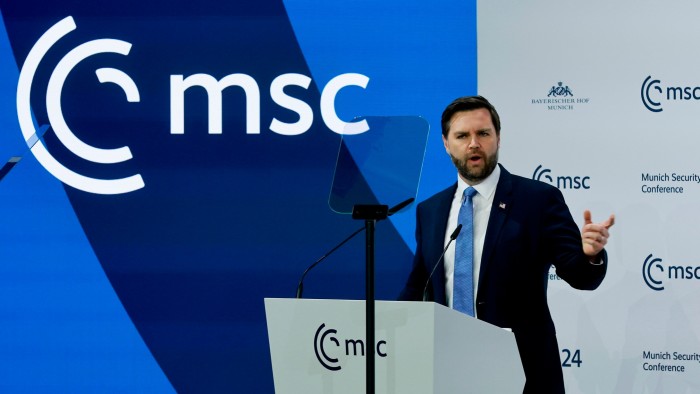
The strategy echoes a speech US vice-president JD Vance delivered to the Munich Security Forum in February, which stunned European allies for its adversarial tone and its claim that the continent faced a greater threat from its own democratic failings than from Russian aggression.
In response to the new document, German foreign minister Johann Wadephul said Europe did “not need outside advice”.
The strategy warns that certain Nato members may become “majority non-European” because of immigration, raising the question as to “whether they will view their place in the world, or their alliance with the United States, in the same way as those who signed the Nato charter”.
Like Biden’s NSS, the strategy mentioned the need to work with allies but it shifted the focus to putting pressure on them to spend more on defence and increasing burden-sharing to reduce reliance on the US.
“The days of the US propping up the entire world like Atlas are over,” said the strategy, which stressed the importance of more spending in the Indo-Pacific region by Japan, South Korea, Australia and also Taiwan.
Referring to security in Asia, it said deterring a conflict over Taiwan was a “priority”. But in another sign of how Trump istaking a less abrasive stance on Beijing to avoid jeopardising his trade deal with Xi Jinping, the strategy used less assertive rhetoric on military threats from China. In a section describing efforts to prevent an attack on Taiwan, it did not mention China.
It largely frames China as an economic challenge, saying Washington will “rebalance America’s economic relationship with China, prioritising reciprocity and fairness to restore American economic independence”.
It did not depict Russia as a threat and said the days of focusing on the Middle East were “thankfully over”. In contrast to its stance on Europe, it calls for “accepting” the Middle East’s nations and leaders “as they are”.
Instead, US dominance of the western hemisphere is defined as the primary objective, in an updated version of the Monroe Doctrine, which claimed the region as a US sphere of influence in 1823.
The NSS calls for a readjustment of the country’s military presence from regions “whose relative import to American national security has declined in recent decades or years” to address urgent threats in “our Hemisphere”.
The shift described in the document is evident in the Caribbean, where the US has its largest deployment of warships, with more than a dozen vessels and 14,000-plus troops. Washington has carried out at least 22 strikes against alleged drug-trafficking boats in the Caribbean and eastern Pacific, killing at least 87 people. It is weighing attacks on Venezuelan soil.
Additional reporting by Amy Mackinnon and Anne-Sylvaine Chassany
Read the full article here