
Stay informed with free updates
Simply sign up to the Technology sector myFT Digest — delivered directly to your inbox.
The writer is professor of physics at the University of California, Santa Barbara, co-founder of Qolab and winner of the 2025 Nobel Prize in physics
This has been a year of phenomenal achievements for quantum computing, proving its scientific principles are sound. Recent advances include Google’s experiment to clarify the boundary of a “quantum observable” — the point at which a quantum system can exceed the abilities of a traditional computer.
However, theory has a speed advantage over reality. While whiteboards fill up with new protocols and algorithms, quantum machines themselves are hitting a wall.
I have been reflecting on the arc of technology I have witnessed in my career — from early experiments in the 1980s to the global quantum race that is now under way. Over the past four decades, the advances in chip fabrication technology and design have fundamentally redefined what is possible.
My conclusion is this: getting to a general-purpose quantum computer — the kind that works like a normal computer but has the exponential processing power of quantum mechanics able to explore a vast number of possibilities at once — requires upwards of 1mn physical qubits (quantum bits). This needs a technological leap of equal magnitude.
The numbers bear out these concerns. Between 2019 and 2025, Google’s quantum chips went from 53 to 105 qubits, a factor-of-two increase in six years. At this pace, I will be long dead before we hit the 1mn qubit mark.
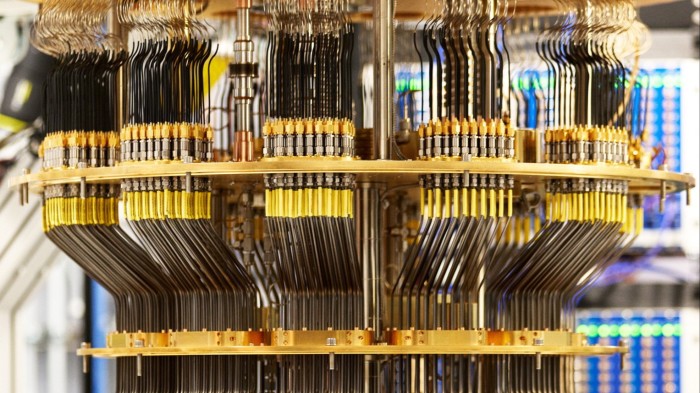
Anyone who has looked inside a modern quantum system can see the truth of this. Look at the diagrams or pictures of devices and what do you see? A jungle of wires and discrete components, all designed to cool and control a single, small chip hidden at the bottom of the cryostat. We have reached a stage where the complexity of the plumbing completely overwhelms the quantum device itself.
My vision is that the entire, spaghetti-like control system must be replaced by a single, integrated chip. Think of it as the transition from the room-sized mainframe computers of the 1960s to the microchips of the 1970s and beyond. That transition wasn’t an innovation in abstract mathematics; it was an industrial engineering marvel.
We need cryogenic integrated circuits to operate at the very low temperatures required for superconducting qubits. Using this approach, we can put not hundreds but 20,000 high-fidelity qubits on a single, clean wafer, and then achieve the target of millions of qubits per system by interconnecting those wafers.
Quantum computing must adopt state-of-the-art chip manufacturing — the same technology that builds billions of transistors into every modern smartphone. This means getting rid of outdated, inefficient methods, such as the 60-year-old lift-off fabrication process used in the development of quantum computing chips, which simply is not clean or scalable enough.
The commitment to building this infrastructure domestically has a greater significance than just technical metrics. I grew up in a blue-collar family and I know that manufacturing is the bedrock of good, sustainable jobs in America. When the classical semiconductor industry offshored much of its fabrication capacity, it shifted technological leadership overseas.
I do not wish my scientific legacy to simply mint a few more billionaires. We should share the transformative benefits of quantum technology with everyone. The next great technological revolution must remain tied to the people who build it.
It has been surprisingly difficult to steer the superconducting qubit community on to this path. I wonder whether modern culture, with its focus on the latest result and aggressive marketing, makes the necessary, difficult and frankly less glamorous work of deep industrial engineering harder to justify and fund. But the path to scalable quantum computers is paved with high-tech fabrication equipment, not just high-impact papers.
It is time for the superconducting qubit community to shift its focus from chasing the next algorithmic demonstration to tackling the immense manufacturing and engineering challenge that lies ahead.
The moment for foundational scientific discovery needs to give way to the era of industrial manufacturing. We have much of the physics; now we need the engineers and technicians. Let us bring the needed manufacturing technology to bear and make this happen quickly, or we risk letting the potential of quantum computing remain forever trapped in a jungle of wires.
Read the full article here