
When federal immigration agents swooped on a construction site in Bethlehem and arrested 17 undocumented foreigners in June, Jon Irons felt a flash of fear that has stayed with him ever since.
Born in Ecuador and adopted as an infant by an American family, Irons, a local school official, thought he might easily share their fate.
“I know that my citizenship, my status, is just a legal decision and that it can be taken away from me,” he said. “We need to acknowledge that everyone’s at risk.”
The raid on June 11 sent a chill through Bethlehem, a former steel- producing town in Pennsylvania about two hours’ drive west of New York whose population is nearly 30 per cent Hispanic.
It also highlighted the divisions that run through Bethlehem and the country as a whole over President Donald Trump’s crackdown on immigration.
The day after the raid, Irons joined about 500 others who protested to demand the detainees’ release. People held up placards saying: “Don’t Bite the Hands that Feed You” and “we speak for those you silenced”.
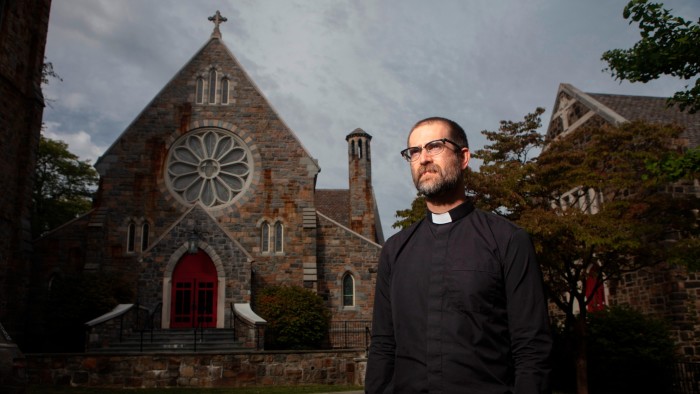
“As a person of faith, as a follower of Jesus, I believe that it was anti-Christian to kidnap people who were simply doing their job,” said Reverend Jon Stratton, dean of Bethlehem’s Nativity Cathedral, one of the protest’s organisers.
The raid in Bethlehem, a small town with an illustrious industrial past, was not reported in the national press. But it showed how the Trump administration’s policies, particularly on immigration, are reaching deep into local communities across America.
What happened there in June was on a much smaller scale than events in big cities such as Los Angeles. In June, Immigration and Customs Enforcement unleashed a crackdown on undocumented workers in LA that caused shockwaves across the country.
ICE agents made dozens of arrests at locations where immigrant labourers gathered to pick up day jobs, triggering mass protests that the Trump administration sought to quell with thousands of National Guard soldiers and US Marines.
No troops were sent into Bethlehem. But the ICE raid still left deep scars. “It’s impacted anybody that is brown-skinned, even myself as a Puerto Rican,” said Guillermo Lopez, a Hispanic community leader who was born and raised in Bethlehem. “I have thoughts of: holy crap, when are they coming after me?”
No one in Bethlehem seems to know where the arrested men, most of them natives of Venezuela and Mexico, are being held or even whether they are still in the US.
“Our fear is that they will disappear into the system,” said Irons. “Yet these were our neighbours.”
There have been further detentions since then. On June 24, Elizabeth DeJesus watched in shock as ICE agents led away her husband, Darwin Contreras, as he attended a routine appointment at Lehigh County Courthouse in neighbouring Allentown.
“I asked the agents, ‘Where are you taking him? what are you doing?’” she said. “I stared them in the eyes but they had nothing to say.”
Contreras, who grew up in Bethlehem and worked as a waiter in Allentown, came to the US from El Salvador as a 7-year-old undocumented minor. He has been held without charge for the past three months and has not been given a court date.
“The Trump administration says they want to deport all the hardened criminals,” DeJesus said. “But Darwin . . . is a good man, he works so hard, he cares for me. He is not a dangerous person.”
A statement by the Department of Homeland Security said Contreras was a “criminal illegal alien” with “convictions including theft and possession of marijuana”. He was, it said, “arrested during a court hearing for driving under the influence”.
Locals had long expected ICE to step up its activities in Bethlehem. During last year’s election campaign Trump repeatedly promised to carry out the largest deportation of illegal immigrants in American history.
Even so, the June 11 raid shocked many. The detained men were construction workers restoring Five 10 Flats, an apartment complex in Bethlehem’s South Side that had been badly damaged by fire in May.
“It’s not like they were selling drugs or running a prostitution ring,” said Lopez. “These were skilled, hard-working carpenters . . . and [ICE] treated them like the worst scum of the earth.”
Edward Owens, a special agent in charge of Homeland Security investigations, said in a statement: “Inspections like these are critical in targeting illegal employment practices that undermine American workers, destabilise labor markets and expose our critical infrastructure to exploitation.”
During ICE’s worksite enforcement actions, “any alien determined to be in violation of US immigration laws may be subject to arrest, detention, and, if removable by final order, removal from the United States”, a statement from the agency said.
Like elsewhere in the country, the inhabitants of Bethlehem are split over the arrests. “[Those people] broke the law,” said Glenn Geissinger, chair of the Republican Committee of Northampton County, of which Bethlehem is a part. “What country on earth is going to turn and look the other way . . . when you enter illegally?”
He said Republican voters in Northampton County — who narrowly supported Trump in last year’s election after having backed Joe Biden in 2020 — “are fully behind what’s going on”. “They’re very grateful that he’s executing on his campaign promises,” Geissinger said.
But across the US, support tor the crackdown is nuanced. A June poll by Pew Research found that 54 per cent of Americans disapproved of increasing ICE raids on workplaces. In another Pew poll later the same month, 23 per cent said they worried that they or someone close to them could be deported.
Tony Iannelli, head of the Greater Lehigh Valley Chamber of Commerce, said he felt ambivalent about ICE’s actions. On the one hand, Trump won last year’s election in part by promising a “more sensible approach” to immigration than that of Biden, and Iannelli himself was “OK with” removing “very bad people who have committed bad crimes”.
But he said workers whose only offence was not having the right papers should be allowed to “legitimise their status”. “If someone’s been here and has proven that they’re an asset to this country and has played by the rules and hasn’t gotten themselves into trouble . . . could there be a process that’s a rapid opportunity [for them] to gain citizenship?”
In a snack bar near the Five 10 Flats, people recalled the June raid with dismay. “You read about this kind of thing on the news, but you don’t expect it to happen here,” said the manager, a woman in her 20s who gave her name as Olivia.
Several of her employees had stopped showing up for work after the arrests, she said. “They’re just trying to make a living and now they’re scared to leave the house.”
Even workers with the correct papers feel anxious, said a waitress at a nearby Mexican restaurant. “[ICE] thinks anyone who looks Hispanic is here illegally,” said the woman, who gave her name as Isabella.
She added that the number of customers had dropped dramatically since June. “All the Mexican gardeners and cleaners who used to have lunch here have stopped coming.”
Some in Bethlehem have mobilised to support local immigrant communities, as they have in other parts of the US. As soon as Trump was sworn in, a group of residents created the Lehigh Valley Emergency Response Network to protect those facing “escalating discrimination, unlawful arrest and unlawful deportation”.
The network aims to provide resources and funds to families affected by the immigration crackdown and deploy volunteers to local courthouses, such as the one where Darwin Contreras was arrested.
After the June detentions it set up a hotline where people could report ICE activity in their neighbourhoods. “What we want to do is to make sure that we are documenting any human rights violations,” said Stratton. The idea is to “bear witness when ICE shows up violently in our communities”.
Elizabeth DeJesus says she is touched by the support she has received from those in Bethlehem and Allentown who helped organise fundraisers for her husband Darwin’s legal fees. But she is also aware that others support ICE’s actions and the Trump immigration agenda more broadly.
“They think ICE makes our community safer,” she said. “I guess they just don’t realise how painful it is to see your family ripped away from you like that.”
Read the full article here